
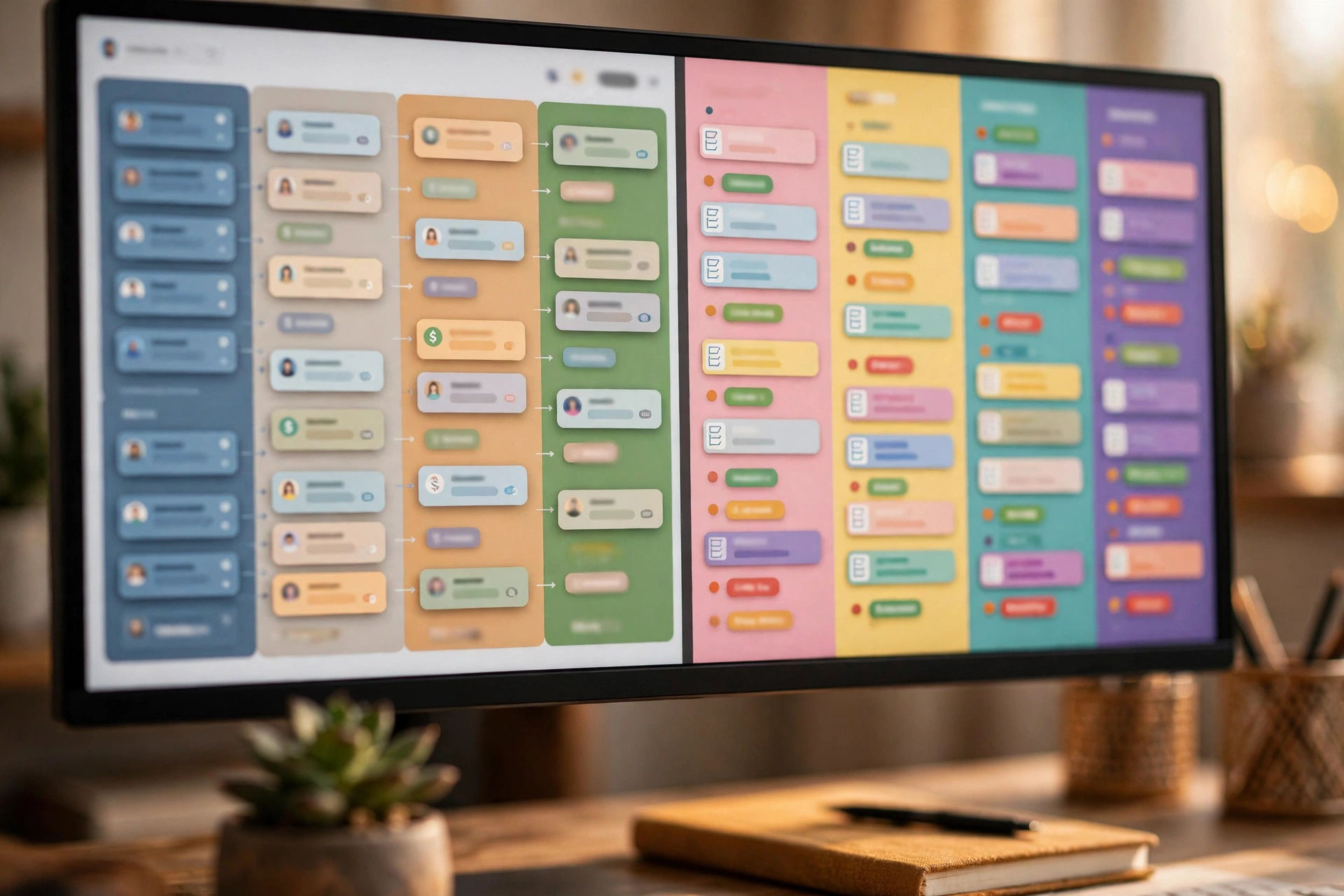
The short answer: pick HubSpot if customers and deals are your core asset — you need a real CRM, ideally with marketing in the same database — and you are a team of 2 (free) or a growing sales team that can justify Professional. Pick Monday if projects and deliverables are your core asset and you want visual boards anyone can read, with a lightweight CRM bolted on at a much lower price. This is not an apples-to-apples comparison, and that is the point: HubSpot is a CRM platform that added light project tracking; Monday is a work-management platform that added a CRM. The decision turns on which job is your business’s centre of gravity — selling, or delivering.
Affiliate disclosure. We don’t have affiliate partnerships with HubSpot or Monday yet, so every link in this article is a plain link to the vendor’s own site — nobody pays us for clicks or signups. If we add affiliate programs later, this article will be updated to say so. Research date for pricing and plan details below: 2026-11-15.
First principles: two different answers to “what runs the business?”
Most comparisons start with feature checklists. That is the wrong starting point here, because HubSpot and Monday overlap on the surface — both have boards, tasks, contacts, automations, dashboards, mobile apps — while being built for different jobs. If features decided this, the comparison would be a tie. What actually decides it is what each product believes the business runs on.
HubSpot’s model: the business runs on the customer record. HubSpot is built around a single shared database — the Smart CRM — where every contact, company, deal, ticket, and email lives once, and every hub (Marketing, Sales, Service, Content) reads and writes the same record. The design bet is that one source of truth for the customer is the feature: marketing nurtures a contact, sales works the deal, service sees the history, and nobody re-enters data or argues about which spreadsheet is current. Everything — the seat-based pricing, the contact-based marketing billing, the onboarding fees — serves a platform that assumes the customer journey is the business.
Monday’s model: the business runs on visible boards. Monday is built around boards made of items with typed columns — status, person, date, numbers, timeline — that anyone can read at a glance. The design bet is that legibility and flexibility are the feature: the same board shape should model a project, a pipeline, a hiring tracker, or an order queue, and a client or new hire should understand it without training. Monday then sells adjacent products for adjacent jobs: Monday CRM for pipelines, Monday Dev for engineering, Monday Service for tickets. It is a visual work OS: separate, readable surfaces that connect.
Derive the consequences and the verdict almost writes itself:
- If selling is the bottleneck (leads to nurture, deals to close, a pipeline to forecast) → HubSpot’s contact-centric database wins, because the tool is built around the customer, not the task.
- If delivering is the bottleneck (projects to run, work to track through stages, mixed audiences who need to see progress) → Monday’s boards win, because the same shape fits every workflow and anyone can read it.
- Cost follows the philosophy. HubSpot is cheap to start (free for 2 users) and brutally expensive at the automation tier, because it prices the platform. Monday is cheap at every tier but bills each product separately, because it prices the surface.
Keep that frame in mind. Every section below is just evidence for it.
Pricing head-to-head (researched 2026-11-15)
All figures below are the annual-billing rates each vendor advertises; month-to-month billing costs more. Confirm current numbers on HubSpot’s Sales Hub pricing page and Monday’s pricing page before you buy — both vendors revise plans and promos regularly, and HubSpot’s Starter price in particular is a moving promo.
HubSpot Sales Hub pricing
| Plan | Price (annual billing) | Price (monthly billing) | Who it fits | Key gates |
|---|---|---|---|---|
| Free | $0 | $0 | A 2-person team needing a real CRM | Up to 2 users, 1 deal pipeline, 1 automated action, HubSpot branding on emails |
| Starter | from about $7/seat/mo (new-customer promo; $20 list) | about $10/seat/mo promo ($20 list) | Small teams standardizing a sales process | Up to 15 pipelines, up to 50 restricted workflows, 500 calling minutes, 500 HubSpot Credits; no sequences |
| Professional | about $90/seat/mo | about $100/seat/mo | Sales teams that need automation | Up to 300 workflows, sequences, forecasting, custom reports, up to 100 pipelines, 3,000 calling minutes; mandatory $1,500 one-time onboarding |
| Enterprise | about $150/seat/mo | about $150/seat/mo | Larger sales orgs | Up to 1,000 workflows, up to 350 pipelines, conversation intelligence; mandatory $3,500 one-time onboarding |
The gotcha that matters: the Starter promo is a discount window, not the price. New customers commonly see $7 per seat per month against a $20 list price. At renewal you pay list — so a 5-person team’s Starter bill goes from about $35 a month in year one to about $100 a month in year two. Model year two before you commit. And the Professional jump is the steepest cliff in mainstream CRM pricing: $7 to $90 per seat is more than 12×, plus $1,500 before you send a single email.
The second gotcha: Sales Hub is not the whole HubSpot. Email marketing, landing pages, and lead nurturing live in Marketing Hub, billed separately — Starter at a $20/seat list price, Professional at $800/month plus a $3,000 onboarding fee, Enterprise at $3,600/month. A team that needs marketing and sales should price the Customer Platform bundle (all hubs, Professional from about $1,300/month) rather than adding hubs one by one. Our full breakdown is in how much HubSpot costs.
Monday pricing — two products, two bills
Monday sells Work Management and CRM as separate products. Each has its own ladder, its own 3-seat minimum, and its own bill.
Monday Work Management
| Plan | Price (annual billing) | Price (monthly billing) | Who it fits | Key gates |
|---|---|---|---|---|
| Free | $0 | $0 | Individuals testing the product | Up to 2 seats, 3 boards, no automations |
| Basic | about $9/seat/mo | about $12/seat/mo | Small teams that just need boards | Unlimited items, 5 GB storage; no Timeline/Gantt, no meaningful automations |
| Standard | about $12/seat/mo | about $14/seat/mo | Most small teams | Timeline and Gantt views, guest access, about 250 automation actions/mo |
| Pro | about $19/seat/mo | about $24/seat/mo | Teams needing time tracking and reporting | Time tracking, formula columns, chart view, about 25,000 automation actions/mo |
| Enterprise | Custom | Custom | Larger orgs | Advanced security, governance, audit log |
Monday CRM
| Plan | Price (annual billing) | Price (monthly billing) | Who it fits | Key gates |
|---|---|---|---|---|
| Basic | about $12/seat/mo | about $18/seat/mo | Small teams tracking deals on boards | 1,000 active contacts and deals, 1 dashboard, 20 quotes/invoices a month, no custom automations |
| Standard | about $17/seat/mo | about $25/seat/mo | Most small sales teams | 10,000 active contacts and deals, about 250 automations/mo, 5 dashboards, AI credits |
| Pro | about $28/seat/mo | about $41/seat/mo | Teams needing sequences and scale | 100,000 active contacts and deals, about 25,000 automations/mo, mass email and email sequences, 50 dashboards |
| Ultimate | Custom | Custom | Larger orgs | Quoted by sales (formerly Enterprise) |
The gotcha that matters: the 3-seat minimum, on each product. Every paid Monday plan requires at least 3 seats, and seats above 3 sell in buckets of 5 (3, 5, 10, 15…). A solo operator pays for 3 seats regardless — about $27/month minimum on Work Management Basic, about $36/month on CRM Basic at annual rates — and a 4-person team buys the 5-seat bucket. There is also no free CRM plan: Monday CRM offers a 14-day trial, then you pay. Budget on the seat block, not the headline per-seat price.
Bold pricing takeaways:
- HubSpot is cheapest at the very bottom and most expensive at the top. Free beats everything for a 2-person team; Professional at about $90/seat plus $1,500 onboarding is roughly triple Monday CRM Pro at about $28/seat.
- Monday’s working CRM tier is Standard at about $17/seat — Basic’s 1,000-contact cap and lack of automations rule it out for most real sales teams, whatever the rate.
- Buying both Monday products is still cheaper than HubSpot Professional. CRM Standard plus Work Management Standard for 5 people is about $145/month combined, against about $450/month for HubSpot Sales Professional alone (before its $1,500 onboarding fee).
- HubSpot’s real price is year-two list, not the promo. Starter at $7 is a first-year number; the honest comparison for a 5-person team is $100/month at list against Monday CRM Standard at $85/month.
What the monthly bill actually looks like
Headline per-seat prices hide the multipliers above. Four worked examples (annual billing, list prices except where the promo is noted, researched 2026-11-15):
Example 1 — 2-person team that needs a CRM.
- HubSpot Free: $0. A genuine CRM — contacts, one pipeline, email tracking, meeting scheduling — for nothing.
- Monday CRM Basic: the 3-seat minimum means 3 × about $12 = about $36/mo, paying for a seat nobody uses, with a 1,000-contact cap and no automations.
HubSpot wins outright. This is the one scenario where the comparison is not close.
Example 2 — 5-person team, CRM only, entry level.
- HubSpot Starter: 5 × about $7 = about $35/mo in year one (promo), stepping up to 5 × $20 = about $100/mo at renewal.
- Monday CRM Standard (the working tier; Basic is too capped): 5 × about $17 = about $85/mo.
Year one, HubSpot’s promo wins. Year two, Monday wins by about $15 a month — and Monday’s price does not step up. If you plan to stay on Starter for more than a year, price it at list.
Example 3 — 5-person team that needs automation and sequences.
- HubSpot Professional: 5 × about $90 = about $450/mo, plus a mandatory $1,500 one-time onboarding fee. Year one ≈ $6,900; year two ≈ $5,400.
- Monday CRM Pro: 5 × about $28 = about $140/mo, no onboarding fee. Year one ≈ $1,680.
This is the single biggest gap in the comparison: about $5,200 a year in year one, about $3,720 a year after that. HubSpot Professional buys deeper automation, forecasting, and the shared customer database — but a small team has to be able to point at the revenue that depth produces, because the price difference alone funds a part-time hire.
Example 4 — 5-person team that needs CRM and project management.
- HubSpot Sales Professional + a separate project tool (Asana Starter at about $10.99/user/mo): about $450 + about $55 = about $505/mo, plus $1,500 onboarding.
- Monday CRM Standard + Monday Work Management Standard: 5 × (about $17 + about $12) = about $145/mo, no onboarding fee.
Monday wins by about $360 a month — but note what each side is missing. The Monday stack has no marketing automation, no landing pages, no email campaigns. The HubSpot stack has no project tool in the bundle at all. Neither side is a complete business platform; each leaves one job to a third product.
For broader context on what CRM software costs across the market, see our guide to how much CRM software costs, and our roundup of the cheapest CRM for small business for the full entry-price ladder.
Features head-to-head
| Capability | HubSpot | Monday |
|---|---|---|
| Core model | Contact-centric CRM: one shared customer database, hubs on top | Board-centric work OS: items with typed columns, separate products per job |
| CRM depth | Full CRM: unlimited contacts, pipelines, sequences (Pro), forecasting, lead scoring | Monday CRM: pipelines, contacts, quotes/invoices; caps at 1,000–100,000 active contacts by tier |
| Project management | Task tracking attached to deals only; no boards, Gantt, dependencies, or workload views | Deep: boards, Timeline/Gantt, Kanban, dependencies, workload views, time tracking (Pro) |
| Marketing automation | Marketing Hub: email campaigns, landing pages, lead nurturing, workflows (separate bill) | None built in — needs Mailchimp, ActiveCampaign, or similar alongside |
| Automations | Workflows: up to 50 restricted (Starter), 300 (Pro), 1,000 (Enterprise) | About 250/mo (Standard), about 25,000/mo (Pro) per product; Basic has effectively none |
| Email sequences | Professional and up (5,000 sequences/account) | Monday CRM Pro only |
| Time tracking | None | Work Management Pro and up |
| Reporting | Custom reports (Pro: up to 100), dashboards, forecasting | Dashboards (1 on CRM Basic, 5 on Standard, 50 on Pro); custom reporting is thinner |
| Integrations | 2,000+ native integrations | 200+ native integrations, paid tiers |
| AI | Breeze agents and HubSpot Credits (500 Starter / 3,000 Pro / 5,000 Enterprise per month) | AI credits bundled on paid tiers; Standard AI on CRM Standard |
| Free plan | Free CRM, $0, up to 2 users | Free Work Management, $0, 2 seats and 3 boards; no free CRM plan |
| Learning curve | Low for CRM basics; the hub and seat model takes real setup time | Low — hours to a useful board; sprawl risk without someone owning the setup |
Bold takeaways from that table:
- CRM depth favors HubSpot at every tier. Unlimited contacts, real sequences, forecasting, and lead scoring are native; Monday CRM is a capable pipeline tool with hard contact caps and sequences gated behind Pro.
- Project management is not a contest. Monday has it; HubSpot does not. A HubSpot buyer who also needs delivery tracking is buying a second tool, full stop.
- Marketing automation is not a contest either — the other way. HubSpot’s Marketing Hub is a real marketing platform; Monday has no equivalent and never will. A Monday buyer who needs campaigns is buying a second tool too.
- Automation caps are the hidden tier gate on both sides. HubSpot Starter’s 50 restricted workflows and Monday Standard’s ≈250 actions a month both run out faster than buyers expect. Count your automations before you pick a tier.
Ease of use and adoption risk
This is where small teams actually succeed or fail, and it maps directly back to the philosophy difference.
HubSpot’s constraint is its completeness: because everything shares one customer database, the setup is the product. Seats, pipelines, properties, and workflows have to be designed before the team can work, and the hub model means someone has to decide which hubs to buy and who gets which seat type. Teams that do that design work get a system where marketing, sales, and service genuinely share one record. Teams that skip it get an expensive contact list with a $90-per-seat bill. The documented pattern is consistent: HubSpot rewards teams that invest a week in setup (or pay the $1,500 onboarding and let HubSpot do it) and punishes teams that treat it as a plug-and-play contact manager.
Monday’s freedom is its risk: because almost anything can be a board, workspaces drift. Different boards use different statuses, columns multiply, and within a few months nobody is sure which board is the source of truth — for projects and for the pipeline. Monday rewards teams that appoint one person to design the boards and statuses up front, and punishes teams that let everyone improvise. The CRM side adds a second drift risk: because CRM and Work Management are separate products, a team can end up with deal data in one place and delivery data in another, connected only by an automation somebody has to maintain.
Practical rule: if nobody on your team wants to be the “systems person,” that is a vote for neither product’s full ambition — take HubSpot free for CRM and a simple board tool for projects, and keep both small. If someone naturally enjoys building the workspace, Monday’s flexibility has the higher ceiling. If someone naturally enjoys building the customer journey, HubSpot’s depth pays off — once the team is big enough to justify Professional.
If you are still deciding what you need from any tool in this category, our guide on how much CRM software costs walks through the requirements checklist before you shortlist vendors, and our HubSpot vs Pipedrive and HubSpot vs Salesforce comparisons cover the other CRM-first options. If budget is the binding constraint, compare both against the options in our roundup of the best free CRM for small business.
When free stops being enough
Both free plans end at the same wall: 2 users. The moment a third person needs in, the free tier is over — but what “over” costs differs sharply.
- HubSpot Free: the caps are 2 users, 1 deal pipeline, 1 automated action, 1,000 marketing contacts, 2,000 branded emails a month, and HubSpot branding on your emails. The first paid tier, Sales Hub Starter, removes the pipeline and branding limits at from about $7 per seat per month on the new-customer promo ($20 list) — but remember the promo reverts at renewal, and sequences still need Professional at about $90 per seat per month plus the $1,500 onboarding fee.
- Monday Free (Work Management): the caps are 2 seats and 3 boards, with no automations and no Timeline/Gantt. The first paid tier, Basic, removes the board cap at about $9 per seat per month — but the 3-seat minimum means about $27 a month even for a 2-person team, and Timeline plus automations still need Standard at about $12. And Monday CRM has no free tier at all: the first paid CRM tier is Basic at about $12 per seat per month, about $36 a month at the 3-seat minimum, and it caps active contacts at 1,000 with no custom automations.
The honest test is which job you are actually doing. If the job is “track customers and deals,” HubSpot free carries a 2-person team further than any free tier in the category, and the first paid step is cheap — for a year. If the job is “run projects on boards,” Monday free runs out at 3 boards and the first paid step is the 3-seat block. Our cheapest CRM for small business roundup ranks the whole paid ladder by true first-year cost if you want to see where both sit against the rest of the market, and HubSpot alternatives covers the cheaper CRM-first options if Professional’s price is the blocker.
The verdict: best for each kind of small business
Pick HubSpot if:
- Customers and deals are your core asset — selling is the bottleneck, and you want marketing, sales, and service sharing one customer database.
- You are a 2-person team and want a real CRM for $0, or a growing sales team that can justify Professional’s automation, sequences, and forecasting.
- You need email marketing and lead nurturing in the same account as your CRM (budget Marketing Hub, or the bundle, on top of Sales Hub).
- Your team is willing to invest setup time — or pay the $1,500 onboarding — to design seats, pipelines, and workflows properly.
Start on Free, then Starter at the promo rate — but set a calendar reminder for the renewal step-up to $20/seat list. Move to Professional only when sequences, real workflows, and forecasting are producing revenue you can point at, not before, because the price jumps more than 12× and the onboarding fee is mandatory.
Pick Monday if:
- Projects and deliverables are your core asset — delivery is the bottleneck, and the same tool should track leads, orders, hires, and projects on boards everyone can read.
- You want CRM and project management in one account and you want the cheapest combined bill: CRM Standard plus Work Management Standard is about $145/month for 5 people, against about $505/month for the equivalent HubSpot stack.
- You track time and want it at the cheapest gate: Work Management Pro at about $19 per seat includes it; HubSpot has no time tracking at any price.
- Your CRM needs are basic — pipeline, contacts, quotes — and you are happy to bolt on a separate email marketing tool for campaigns.
Start on CRM Standard (about $17/seat/mo annual) and Work Management Standard (about $12/seat/mo annual) — both Basic tiers are too capped for real work, and both carry the 3-seat minimum, so budget the seat block. Move to Pro on either product only when the automation cap or the sequences gate actually bites.
The one-line verdict: HubSpot is the better customer platform; Monday is the better work platform. Choose based on whether your bottleneck is turning strangers into customers and customers into revenue, or turning work into delivered projects everyone can see — then let the pricing tables above confirm the choice fits your budget, at year-two prices, not the promo.
Pricing and plan details in this article were researched on 2026-11-15 from HubSpot’s official Sales Hub pricing page and current third-party pricing checks (October–November 2026), and Monday’s official pricing page via third-party checks verified against it in September–November 2026. Both vendors change plans, promos, and prices without notice; verify the tier, seat minimums, and onboarding fees on the official pricing pages before purchasing.